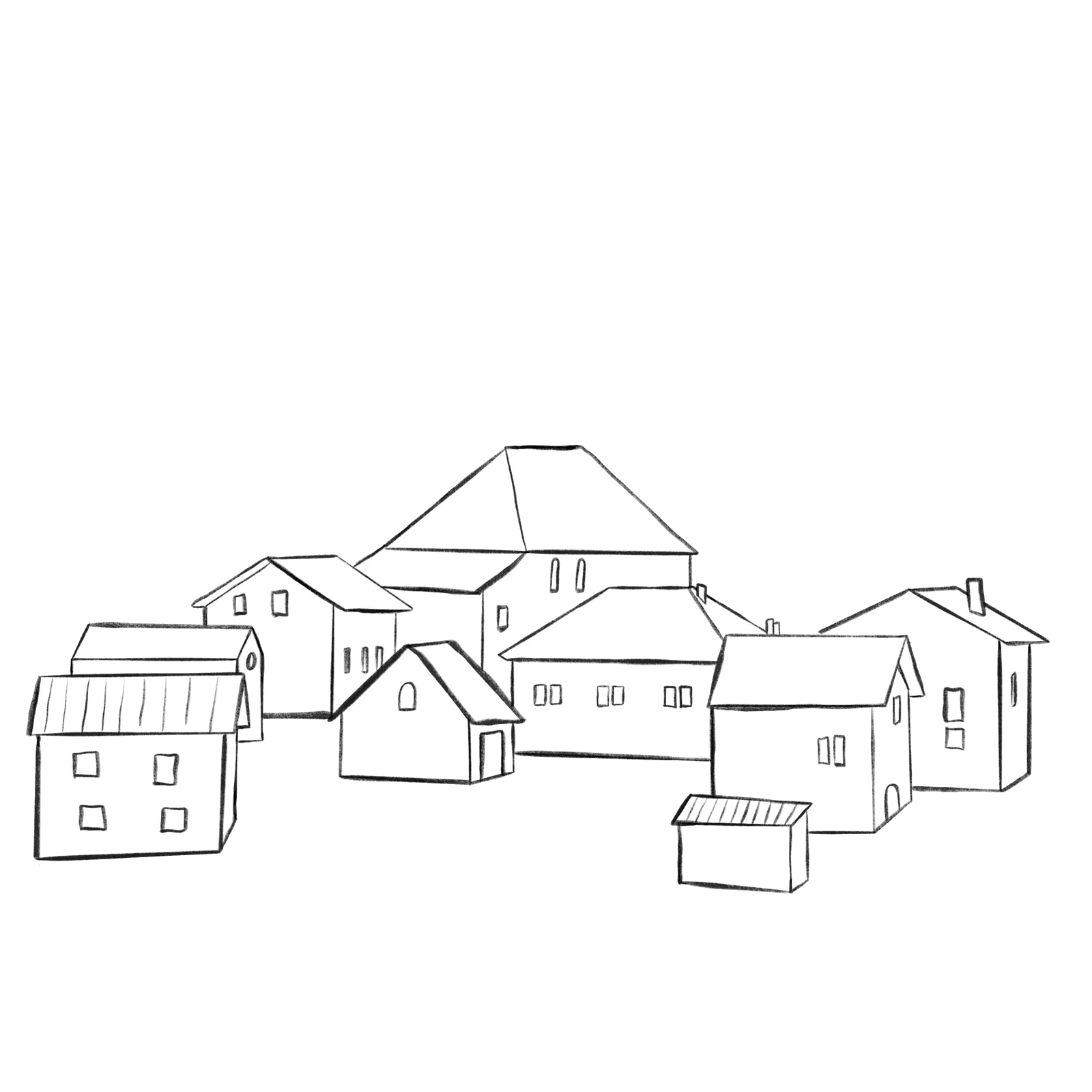
We Crave a Village
Large organizations don’t eliminate our need for a village. We just find one inside them.
The Hutterites are a communal Anabaptist sect that has farmed the plains of North America since the 1870s. They have a practice almost nobody outside the community knows about. When a colony’s population creeps up toward 150, it typically divides. One group of roughly 150 people stays put, and another of about 50 leaves to found a new colony a few miles away. This isn’t scripture. It’s something the community arrived at through generations of practical experience. Past a certain size, informal peer pressure stops being enough to hold the group together. So they split before it fails.
Nobody at the colony was running an experiment. They were just responding, over and over, across a century and a half, to something that kept breaking whenever the group grew too large. They kept discovering the same thing: past a certain size, people no longer knew one another well enough for the community to regulate itself informally. Their response was to become two smaller communities again. And they are far from the only ones who have stumbled onto roughly the same answer.
A number that keeps reappearing, not a theory that explains it
British anthropologist Robin Dunbar noticed the same pattern across primate troops and human communities. He proposed an explanation: something like 150 is the rough ceiling on how many people a person can keep track of as real, known relationships, the kind where you know who someone is and how they fit into the group. Beneath that ceiling, Dunbar described smaller nested layers too: a handful of closest relationships, a wider circle of good friends, a broader band beyond that.
Dunbar’s theory is one attempt to explain something people had already been living by for a very long time. For most of human history, day-to-day social life happened mostly within groups this size: close bands of a few dozen, wider gatherings of a few hundred. Nobody needed a theory to live that way. It was just what a life looked like.
What’s interesting isn’t the precision of the number. It’s that Hutterite colonies, primate troops, and (as we’ll get to) modern institutions that have never heard of Dunbar keep landing in the same neighborhood, through lived experience rather than research. That convergence is the actual subject here. Dunbar is a plausible explanation for why it happens. It isn’t the point.
The point is what happens once organizations get built at a scale no version of that instinct was ever designed for.
The village doesn’t disappear. It gets rebuilt, whether anyone plans for it or not.
Almost nobody who works at a four-thousand-person company feels like they belong to a four-thousand-person company. They belong to something much smaller sitting inside it: a team, a handful of colleagues, the people they’d actually call if something went wrong, a group chat that isn’t on any official directory. That smaller thing is doing the emotional work the whole organization can’t do. It’s the modern village, and it exists whether or not the org chart has a box for it.
A large organization doesn’t get to decide whether village-sized groups form inside it.
They will. The only question is whether they emerge by design or by accident.
The instinct to belong to a known group doesn’t switch off just because the paycheck comes from somewhere much bigger. What the organization actually gets to decide is narrower than that, and more consequential. Not whether these groups exist, but whether they take shape on purpose, or by accident, in whatever gaps happen to be lying around in the org chart.
This may be why company-wide culture initiatives so often disappoint. People don’t experience culture primarily through the whole organization. They experience it through the village-sized group they actually inhabit inside it. Company-wide culture isn’t meaningless, but it’s never felt directly. It comes through whichever smaller group stands between a person and the rest of the company.
Left to form by accident, the instinct is neutral, not benevolent. The same mechanism that produces a tight, loyal team willing to cover for each other under pressure also produces the clique that stops sharing information with the department next door, the in-group that quietly closes ranks against a new hire, the “real team” that treats everyone outside it as someone else’s problem. Both outcomes come from the identical human need. What separates them isn’t the strength of the bond. It’s whether anyone designed for it, or just let it happen in whatever shape was left over.
What it looks like when someone designs for it on purpose
A handful of institutions have found their way to the same answer, almost always the hard way, and rarely by citing any research at all.
Militaries built their unit sizes through centuries of trial and error about what a person could actually lead and trust under pressure: small squads, larger platoons, still-larger companies, with formal structure taking over above that. Nobody designed that ladder from a cognitive-science paper. They built it around what held together in the field. The result loosely resembles the same nested scale that shows up elsewhere, worth noticing without leaning on it too hard.
Some companies have arrived somewhere similar on purpose. Amazon’s “two-pizza team” rule was a bet that a team past a certain size stops coordinating the way a small one does. W.L. Gore capped its manufacturing plants at 150 employees and a matching number of parking spaces. Once the lot filled, it built the next plant next door instead of expanding the one it had. Neither company solved belonging with a better mission statement. They solved it by treating group size as something that had to be designed, not left to grow indefinitely.
None of these examples are proof of a magic number. What they share is a recognition that belonging doesn’t scale the way headcount does. Past some point specific to each context, adding more people to a single unit doesn’t create more belonging. It just adds more people who will eventually go build a smaller group of their own to actually belong to.
What changes once you see it
Most growing organizations ask some version of the same question: how do we preserve our culture as we scale? That question usually assumes culture is a substance, something that can leak out or get diluted if you’re not careful. I don’t think that’s what’s actually happening.
Culture doesn’t disappear as organizations grow. It becomes local. It moves out of the whole organization and into whatever village-sized groups people have managed to build for themselves, the ones designed on purpose and the ones that just happened. The better question isn’t how to preserve culture at scale. It’s where belonging actually lives right now, inside your organization, and whether that’s a place anyone chose.
Field Questions
- Where does belonging actually live in your organization right now, and did anyone design that, or did it just happen?
- What’s the smallest group most people would name if you asked who they’d call when something went wrong, and does your org chart know it exists?
- Is a tight-knit group in your organization currently a healthy village, or has it curdled into a clique that’s stopped sharing information with everyone outside it?
- If you treated belonging as something that has to be designed at the team level, not assumed at the company level, what would you build differently?
Further reading: Robin Dunbar’s research on cognitive limits to stable social relationships; the Hutterite practice of dividing colonies once informal peer accountability breaks down at scale.